Following an April 2022 workshop exploring animal methods bias in publishing, the Coalition to Illuminate and Address Animal Methods Bias (COLAAB) was formed. We are an international collaboration of researchers and advocates led by the Physicians Committee for Responsible Medicine and including representatives from the Johns Hopkins Center for Alternatives to Animal Testing, University of Rochester, Utrecht University, York St John University, Centre for Human Specific Research, Humane World for Animals, People for the Ethical Treatment of Animals, as well as independent scholars.
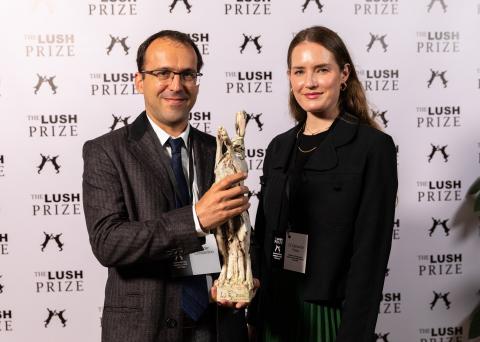
In 2024, we were honored to win the Lush Prize Recognition Award for Major Science Collaboration!
COLAAB Structure
Within the COLAAB, the Mitigation Working Group aims to (1) develop and implement tools and tactics to mitigate animal methods bias and (2) engage journals, funders, institutions, editors, authors, and early-career researchers about this issue. This group has developed the Author Guide for Addressing Animal Methods Bias in Publishing, which contains information that researchers may use during study design, during manuscript preparation and submission, and during peer review to avoid or address reviewers’ potential animal methods bias. Adapted for this website, the Author Guide was prepared in its original form by Catharine E. Krebs, Celean Camp, Helder Constantino, Lilas Courtot, Owen Kavanagh, Janine McCarthy, Melanie-Jasmin Ort, Shaarika Sarasija, and Emily R. Trunnell and published in Advanced Science. Currently, the Mitigation Working Group engages with editors to promote simple peer review interventions to help mitigate animal methods bias and advocates for policy changes with funders of biomedical research to address review-related barriers facing researchers who use nonanimal approaches.
The Evidence Working Group aims to (1) collect and analyze data and evidence about animal methods bias and (2) describe animal methods bias and its causes, impacts, and importance to the broader scientific community. This group conducted an initial survey to assess authors’ experiences and perceptions of animal methods bias during manuscript peer review, establishing the first ever empirical evidence of this bias. Currently, the Evidence Working Group is conducting a larger, follow-up survey, regional surveys, as well as an analysis of animal use in publications to further demonstrate evidence of animal methods bias and its practical impacts on biomedical research.